Top of the World
A Woman of SubstanceTop of the World is Emma Harte’s name for a cherished place on the moors near Ramsden Crags, above Fairley. More than a landmark, it is a recurring refuge where she experiences love and loss, keeps faith with her mother’s memory, and encounters the history linking the Harte and Fairley families. Its significance gathers across generations: a high place associated first with youthful promises and heartbreak, it becomes a landscape in which memory can endure and an old family division can finally begin to close.
Setting and landscape
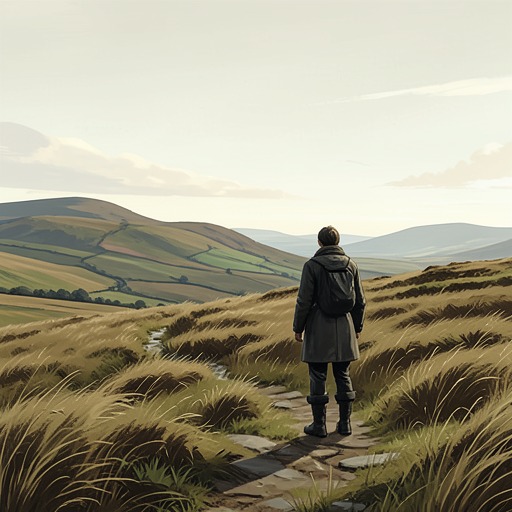
Fairley village lies in the foothills of the Pennines, within the West Riding landscape that also shapes the Fairley wool business. The narrative places Top of the World among the moors and crags above the village, near Ramsden Ghyll. The name is Emma’s and her mother’s, not simply a formal geographical label: villagers also call the striking rock formations Flying Horses. Seen from the moorland, the crags appear like rearing horses against the horizon, an impression that gives the place an imaginative identity as well as a physical one.
The terrain is not uniformly welcoming. In winter, the approach from Ramsden Ghyll rises over a narrow, steep track scattered with rocks and roots frozen into the ground. The high ground can be bleak beneath rain and wind, and February frost makes the moor savage and desolate. In summer, however, the shelter beneath Ramsden Crags offers a gentler aspect: heather, ferns, young bilberry leaves, and a ledge protected from the wind. Emma’s attachment to the place depends partly on this contrast. The same exposed heights that can feel severe also offer space, shelter, and a view over the world below.
The surrounding region is described in material as well as emotional terms. In the West Riding, millstone grit, coal measures, peat, and clay support short-haired sheep and coarse grass, while streams fed by the rain-heavy Atlantic winds provide soft water that is kinder to fibres than the hard water of limestone country farther north. Sheep’s wool and soft water help explain the growth of the Fairley wool business. Top of the World belongs to this working landscape: the moors are not an escape from the region’s economic history, but part of the setting in which the family’s land and industry have developed.
Emma’s refuge and family memory
Emma repeatedly turns to the high ground as a place to be alone with her mother’s memory. After Elizabeth Harte dies, Emma rejects the idea that her mother’s suffering and death could be reconciled with God’s will, then runs from the house toward the moors. Jack Harte, grieving too, identifies Top of the World as the place where Elizabeth must now be. His words connect the landscape to the family’s bereavement, while Emma’s flight makes it a space where grief and anger can be lived rather than explained away.
Later, when Emma returns to Fairley, she remembers Jack’s request, conveyed by Winston Harte: she is to pick a sprig of heather from the high ground for her parents and keep it as a remembrance. Emma says she will go to the cemetery and then climb to Top of the World, although she doubts there will be heather at that time of year. She insists on going alone, refusing Winston and Frank’s offer to accompany her. The errand is therefore both a response to her father’s dying wish and an assertion of her need to face loss privately.
The place continues to hold Elizabeth’s presence for Emma after the immediate shock of bereavement. When she pauses beneath Ramsden Crags with a heavy basket of clothes, she feels her mother more strongly there than in the cottage they had shared. She imagines Elizabeth’s face in the moorland shadows and hears her laughter in the crags; when the image fades, Emma gathers herself and resumes her journey. The episode presents the landscape not as proof that the dead have returned, but as the setting in which memory becomes intensely present and helps Emma continue.
Edwin, youthful love, and the cave
Top of the World is also bound to Emma and Edwin Fairley’s early relationship. In Emma’s memory of being sixteen, she runs across the Yorkshire moors to meet Edwin at the rocks beneath Ramsden Crags. He climbs toward the ledge where they sit protected from the wind, looking down over the country below. When Emma reaches him breathless, Edwin reassures her that they will live forever there. The promise belongs to youthful intimacy, but its later recurrence lends it a poignancy that neither character could have understood at the time.
The same landscape provides the setting for their return to closeness. After a storm, Edwin asks Emma to meet him at the cave at Top of the World once the weather improves. The cave beneath Ramsden Crags is a distinct place within the larger moorland setting, connected to their private meetings and the consequences of their relationship. The distinction matters: Top of the World encompasses the open heights and remembered ledge, while the cave offers a more secluded site within that landscape.
The place’s association with Edwin does not erase the pain attached to their history. In a later dream, as Emma lies gravely ill, she becomes the young girl running over the moors again and sees Edwin climbing toward their ledge. She calls after him, but the wind carries her voice away. When he helps her up, he repeats the assurance that she will never die and that they will live forever at Top of the World. The dream then fragments as she falls asleep. After surviving another attack of bronchial pneumonia at seventy-eight and leaving the London Clinic three weeks later, Emma silently understands her survival through her determination to live. The remembered promise and the physical struggle to recover meet in the same landscape, without making the dream a literal explanation for her recovery.
A shared history and an ending
Top of the World ultimately links Emma and Edwin’s story to an older relationship between their families. Adam Fairley once painted a portrait of Elizabeth Harte on a small stone. When he sees it years later, he remembers Elizabeth beneath the crags and the moment she told him she was going to have a baby. The image brings back a concealed past: Jim Fairley later explains to Emma that Adam and Elizabeth had been lovers, not merely friends. The stone portrait carries that history from the moors into the family’s later generations.
Adam’s account, relayed by Jim, places the old romance within a repeated pattern: Fairley men and Harte women have been drawn to one another but thwarted in love. He asks that the pattern end with the younger generation and that Emma forgive him for rejecting her in the rose garden. At the end of his life, Edwin recalls Top of the World as he announces that he is going back there, then dies peacefully. The scene returns the novel to the promise made on the ledge, now transformed by the losses and estrangements that followed it.
When Emma learns the truth about Adam and Elizabeth, she recognizes the stone as her mother’s portrait and says she had suspected a connection between them. She treasures it because she has no photograph of Elizabeth. The family’s reconciliation is not achieved by the landscape alone: Emma has already relented about Paula and Jim’s marriage. Yet the story told through the stone gives that decision a broader meaning. Top of the World is where private memories of love and grief become part of a shared family history, and where a promise of enduring life acquires its final force as remembrance, forgiveness, and the possibility of ending an inherited heartbreak.